· Hamza · Artificial Intelligence · 4 min read
What Is Machine Learning? A Complete Beginner's Guide (2026)
Learn what Machine Learning is, how it works, its types, real-world applications, benefits, and why it powers many of today's AI technologies.
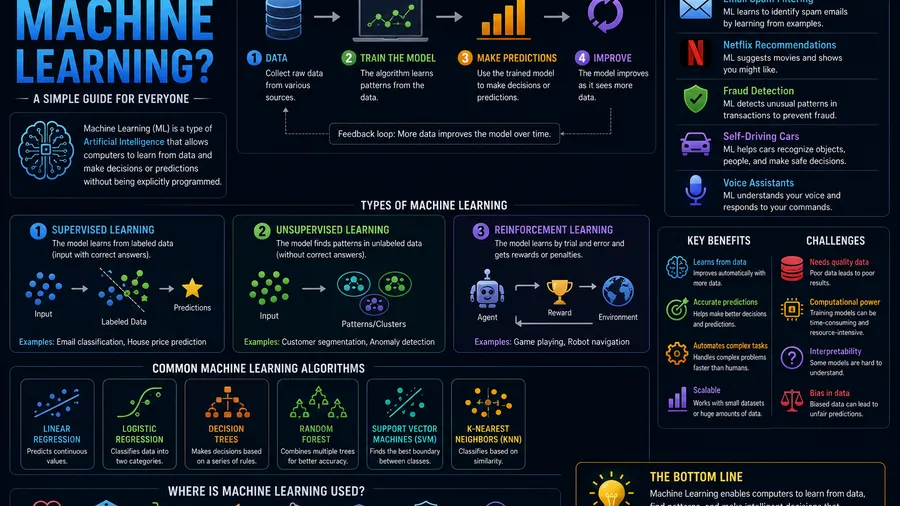
What Is Machine Learning? A Complete Beginner’s Guide (2026)
Machine Learning (ML) is one of the most exciting fields in Artificial Intelligence (AI). It enables computers to learn from data, recognize patterns, and make predictions without being explicitly programmed for every task.
In this guide, you’ll learn what Machine Learning is, how it works, its different types, real-world applications, benefits, challenges, and why it’s shaping the future of technology.
What Is Machine Learning?
Machine Learning is a branch of Artificial Intelligence that allows computers to learn from data and improve their performance through experience.
Instead of following only fixed rules, Machine Learning models analyze data, identify patterns, and make decisions based on what they have learned.
The more high-quality data a model receives, the better its predictions usually become.
How Does Machine Learning Work?
Machine Learning follows a series of steps:
- Collect data.
- Clean and prepare the data.
- Train a Machine Learning model.
- Test the model using new data.
- Make predictions.
- Improve the model over time.
This learning process allows AI systems to become more accurate as they process more information.
Types of Machine Learning
Machine Learning is generally divided into three main categories.
Supervised Learning
Supervised Learning uses labeled data.
The model learns by comparing inputs with known correct outputs.
Examples include:
- Email spam detection
- House price prediction
- Medical diagnosis
- Image classification
Unsupervised Learning
Unsupervised Learning works with data that has no labels.
The model identifies hidden patterns and relationships on its own.
Examples include:
- Customer segmentation
- Recommendation systems
- Data clustering
- Market analysis
Reinforcement Learning
Reinforcement Learning teaches an AI system through rewards and penalties.
The model learns by interacting with its environment and improving its decisions over time.
Examples include:
- Self-driving cars
- Robotics
- Video game AI
- Autonomous drones
Machine Learning vs Artificial Intelligence
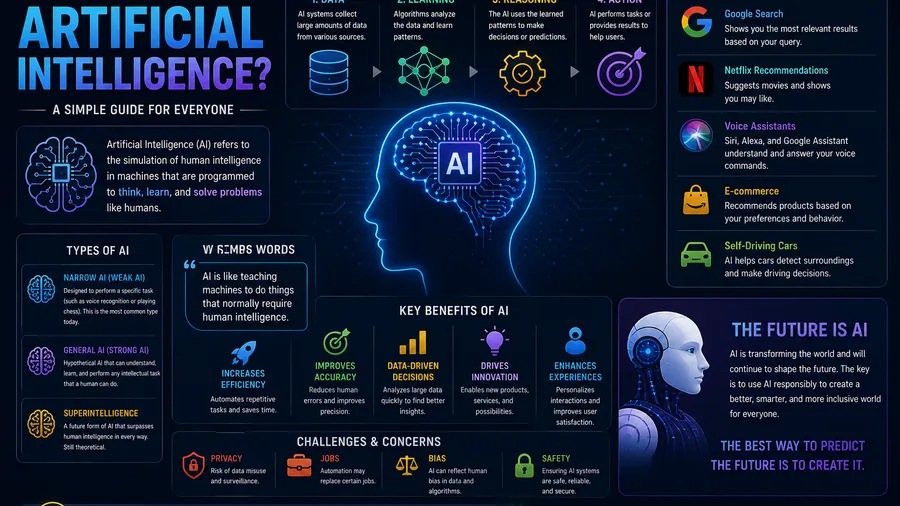
Artificial Intelligence is the broader field focused on creating systems that simulate human intelligence.
Machine Learning is a subset of AI that enables systems to learn from data automatically.
In simple terms:
- AI is the overall concept.
- Machine Learning is one of the methods used to build AI.
Machine Learning vs Deep Learning
Deep Learning is a specialized branch of Machine Learning.
Machine Learning:
- Uses traditional algorithms
- Often requires manual feature selection
- Works well with structured data
Deep Learning:
- Uses artificial neural networks
- Learns features automatically
- Excels with images, speech, and natural language
Deep Learning powers many advanced AI systems like ChatGPT and image generators.
Real-World Applications
Machine Learning is used across many industries.
Examples include:
- Search engines
- Recommendation systems
- Fraud detection
- Healthcare diagnostics
- Financial forecasting
- Voice assistants
- Image recognition
- Autonomous vehicles
- Cybersecurity
- Predictive maintenance
Many of the digital services people use every day rely on Machine Learning.
Popular Machine Learning Algorithms
Some commonly used algorithms include:
- Linear Regression
- Logistic Regression
- Decision Trees
- Random Forest
- Support Vector Machines (SVM)
- K-Means Clustering
- Naive Bayes
- Neural Networks
Different algorithms are suited to different types of problems.
Benefits of Machine Learning
Machine Learning offers many advantages.
These include:
- Improved accuracy
- Faster decision-making
- Automation of repetitive tasks
- Better predictions
- Personalized recommendations
- Increased productivity
- Scalability
- Continuous improvement
These benefits make Machine Learning valuable across countless industries.
Challenges of Machine Learning
Machine Learning also presents challenges.
Common issues include:
- Large data requirements
- Data quality problems
- Bias in training data
- High computing costs
- Model interpretability
- Privacy concerns
- Overfitting
Careful data preparation and testing help reduce these challenges.
Industries Using Machine Learning
Machine Learning is widely used in:
- Healthcare
- Banking
- E-commerce
- Manufacturing
- Transportation
- Marketing
- Education
- Cybersecurity
- Entertainment
- Agriculture
Its adoption continues to grow as organizations seek smarter, data-driven solutions.
Popular Machine Learning Tools
Developers commonly use:
- TensorFlow
- PyTorch
- Scikit-learn
- Keras
- XGBoost
- Pandas
- NumPy
- Jupyter Notebook
These tools simplify the process of building and training Machine Learning models.
Frequently Asked Questions
What is Machine Learning?
Machine Learning is a branch of Artificial Intelligence that enables computers to learn from data and make predictions without being explicitly programmed for every task.
Is Machine Learning the same as AI?
No. Machine Learning is a subset of Artificial Intelligence. AI is the broader field, while Machine Learning is one of the techniques used to create intelligent systems.
Where is Machine Learning used?
Machine Learning is used in healthcare, finance, e-commerce, search engines, recommendation systems, cybersecurity, autonomous vehicles, and many other industries.
Do I need to know programming to learn Machine Learning?
Yes. Python is the most popular programming language for Machine Learning because of its simplicity and extensive ecosystem of AI libraries.
Is Machine Learning worth learning in 2026?
Absolutely. As AI adoption continues to grow, Machine Learning remains one of the most valuable skills for developers, data scientists, and technology professionals.
Conclusion
Machine Learning is one of the driving forces behind today’s Artificial Intelligence revolution. By learning from data, identifying patterns, and making intelligent predictions, Machine Learning powers everything from recommendation systems and virtual assistants to medical diagnostics and autonomous vehicles.
Whether you’re interested in AI, data science, or software development, understanding Machine Learning provides a strong foundation for building intelligent applications and preparing for the future of technology.