· Hamza · AI · 4 min read
The Future of AI: How Artificial Intelligence Will Shape Our World
Discover the future of Artificial Intelligence, emerging trends, business applications, challenges, and how AI will transform industries in the coming years.
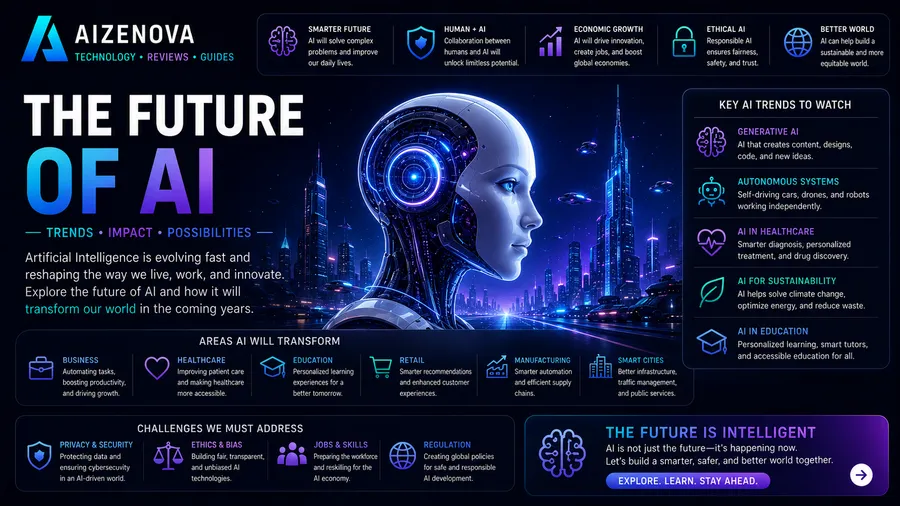
The Future of AI: How Artificial Intelligence Will Shape Our World
Artificial Intelligence (AI) is no longer a futuristic concept—it is already transforming the way we work, communicate, learn, and solve problems. From virtual assistants and autonomous vehicles to healthcare and finance, AI is becoming one of the most influential technologies of the 21st century.
In this guide, we’ll explore the future of AI, the industries it will transform, upcoming trends, challenges, and what individuals and businesses can expect in the years ahead.
What Is Artificial Intelligence?
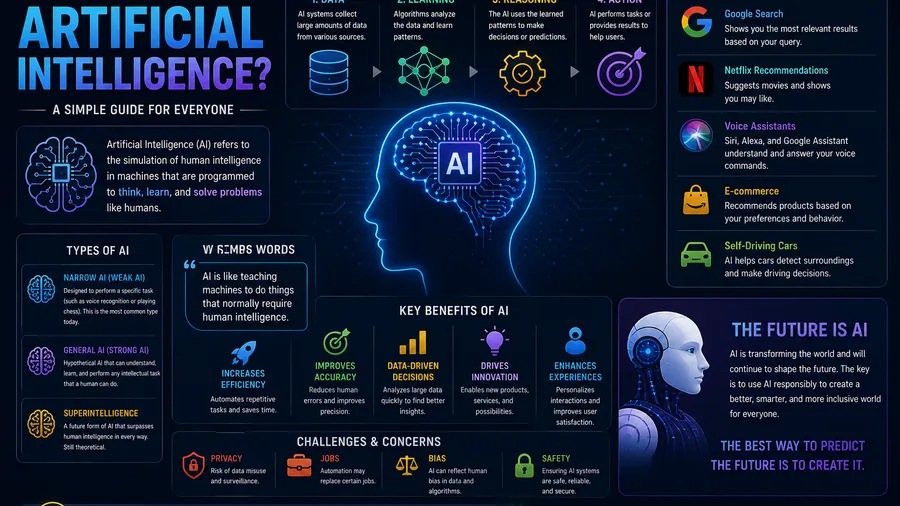
Artificial Intelligence refers to computer systems that can perform tasks typically requiring human intelligence.
These tasks include:
- Learning from data
- Understanding language
- Recognizing images
- Solving problems
- Making predictions
- Generating content
- Automating decisions
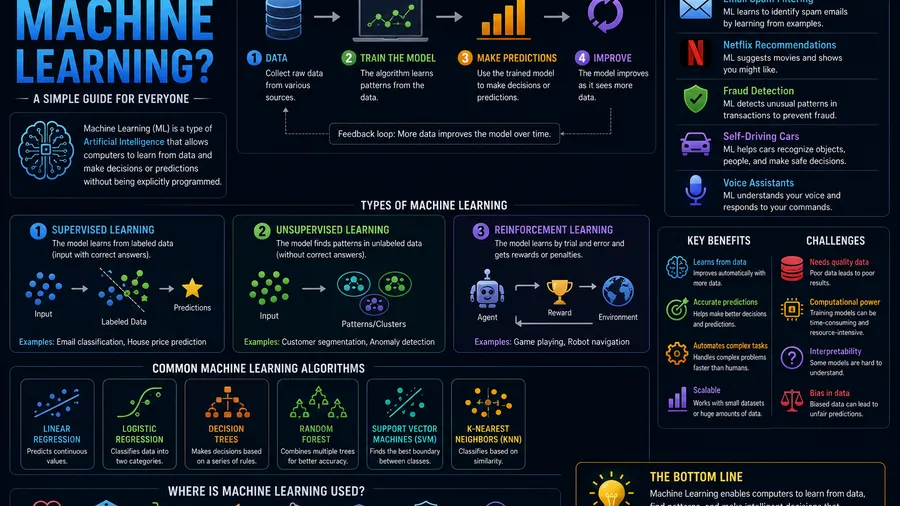
Modern AI relies heavily on machine learning and deep learning algorithms to improve its performance over time.
Why AI Is Growing So Quickly
Several factors have accelerated AI development:
- More powerful computers
- Massive amounts of digital data
- Cloud computing
- Better machine learning algorithms
- Open-source AI frameworks
- Increased investment from governments and businesses
These advances have made AI more accessible than ever before.
Industries AI Will Transform
Healthcare
AI is improving healthcare by helping doctors:
- Detect diseases earlier
- Analyze medical images
- Develop new medicines
- Personalize treatments
- Monitor patients remotely
Healthcare is expected to remain one of AI’s fastest-growing sectors.
Business
Companies use AI to:
- Automate repetitive tasks
- Improve customer support
- Analyze business data
- Forecast demand
- Optimize operations
- Increase productivity
Businesses adopting AI often gain a competitive advantage.
Education
AI-powered learning platforms can:
- Personalize lessons
- Generate quizzes
- Translate educational content
- Assist teachers
- Support students with tutoring
AI is making education more accessible and adaptive.
Finance
Financial institutions use AI for:
- Fraud detection
- Credit scoring
- Investment analysis
- Customer service
- Risk management
- Algorithmic trading
AI helps improve both efficiency and security.
Transportation
The transportation industry benefits from AI through:
- Autonomous vehicles
- Traffic optimization
- Route planning
- Fleet management
- Predictive maintenance
These technologies aim to improve safety and reduce costs.
Manufacturing
Factories increasingly rely on AI for:
- Quality control
- Robotics
- Predictive maintenance
- Supply chain optimization
- Production planning
Smart manufacturing increases efficiency while reducing downtime.
Emerging AI Trends
Generative AI
Generative AI can create:
- Text
- Images
- Videos
- Music
- Software code
- Presentations
This technology is transforming creative industries and business workflows.
AI Agents
AI agents can complete multi-step tasks with minimal human guidance.
Examples include:
- Research assistants
- Customer service agents
- Coding assistants
- Business automation tools
AI agents are expected to become increasingly capable over the next decade.
Multimodal AI
Future AI systems will understand and combine:
- Text
- Images
- Audio
- Video
- Documents
This enables more natural interactions and broader problem-solving capabilities.
Robotics
AI-powered robots are expanding into:
- Warehouses
- Hospitals
- Agriculture
- Manufacturing
- Logistics
Advances in robotics will allow machines to perform more complex physical tasks.
Benefits of AI
Artificial Intelligence offers many advantages:
- Higher productivity
- Faster decision-making
- Automation of repetitive work
- Improved customer experiences
- Better data analysis
- Reduced operational costs
- Increased innovation
- Personalized services
These benefits continue to drive AI adoption worldwide.
Challenges of AI
Despite its potential, AI also presents important challenges:
- Privacy concerns
- Data security
- Bias in AI systems
- Misinformation
- Job displacement
- Ethical questions
- Regulatory uncertainty
Governments, businesses, and researchers are working to address these issues through responsible AI development.
Will AI Replace Jobs?
AI is expected to automate some routine tasks, but it is also creating new opportunities.
Rather than replacing every job, AI is likely to change how many professions operate.
Workers who develop skills in:
- AI tools
- Programming
- Data analysis
- Critical thinking
- Creativity
- Communication
will be better prepared for the future job market.
Skills to Learn for the AI Era
To stay competitive, consider learning:
- Artificial Intelligence fundamentals
- Prompt engineering
- Python programming
- Machine Learning
- Data Science
- Cloud Computing
- Cybersecurity
- Automation
- Digital Marketing
- Problem-solving
Continuous learning will remain essential as AI evolves.
Frequently Asked Questions
Will AI replace humans?
AI is designed to assist and automate many tasks, but human creativity, judgment, empathy, and decision-making remain essential in many professions.
Which industries will benefit the most from AI?
Healthcare, finance, education, manufacturing, transportation, software development, and customer service are among the industries expected to see significant benefits.
Is AI a good career?
Yes. AI-related careers continue to grow rapidly, with strong demand for professionals in machine learning, data science, AI engineering, robotics, and related fields.
What are AI agents?
AI agents are systems capable of completing complex, multi-step tasks with limited human input, often by planning, reasoning, and interacting with digital tools.
Should I learn AI in 2026?
Absolutely. Understanding AI concepts and tools can improve productivity and create valuable career opportunities across many industries.
Conclusion
Artificial Intelligence is shaping the future of technology, business, and society. As AI systems become more capable, they will continue to transform industries, improve productivity, and create new opportunities for innovation.
While challenges such as privacy, ethics, and workforce adaptation must be addressed, the future of AI remains incredibly promising. Individuals and businesses that embrace AI responsibly and continue learning will be better positioned to succeed in the rapidly evolving digital world.