· AIZENOVA · Programming · 9 min read
Best Programming Languages to Learn in 2026: Complete Beginner's Guide
Discover the best programming languages to learn in 2026. Compare Python, JavaScript, Java, C#, Go, Rust, Kotlin, Swift, and more based on jobs, salary, popularity, and ease of learning.
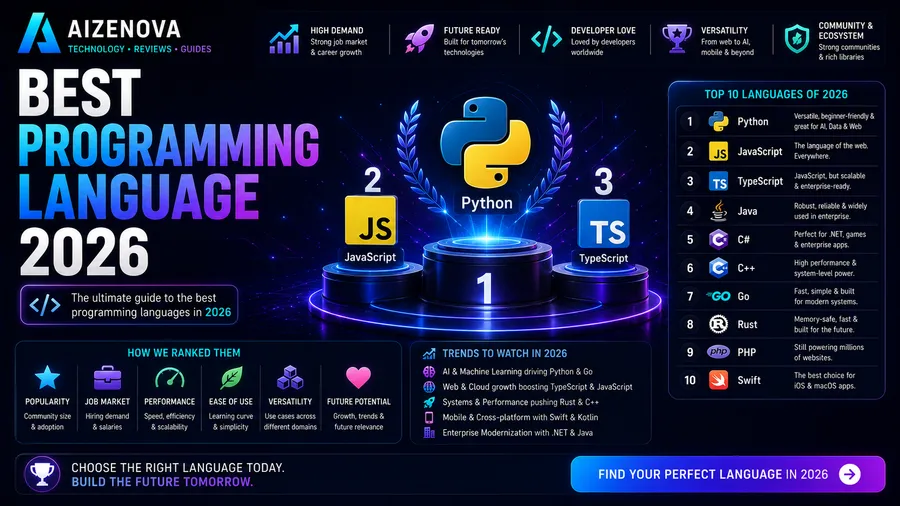
Programming has become one of the most valuable skills in today’s digital world.
Whether you want to become a software developer, build websites, create mobile apps, analyze data, develop artificial intelligence, or automate everyday tasks, choosing the right programming language is one of the most important decisions you’ll make.
The good news is that there is no single “best” programming language for everyone.
Each language has its own strengths, learning curve, ecosystem, and ideal use cases.
This guide compares the most popular programming languages in 2026, explains where each one excels, and helps you decide which language best matches your career goals.
Quick Summary
| Category | Programming |
| Languages Covered | 12 |
| Best For | Beginners & Professionals |
| Reading Time | 22 Minutes |
| Difficulty | Beginner |
| Last Updated | August 5, 2026 |
Definition
A programming language is a formal language used to write instructions that computers can understand and execute. Different programming languages are designed for different purposes, from web development and mobile apps to artificial intelligence and operating systems.
Table of Contents
- Why Learn Programming?
- How to Choose a Programming Language
- Best Programming Languages in 2026
- Python
- JavaScript
- TypeScript
- Java
- C#
- C++
- Go
- Rust
- Kotlin
- Swift
- PHP
- SQL
- Which Language Should You Learn?
- Frequently Asked Questions
- Conclusion
Why Learn Programming?
Programming is no longer limited to software engineers.
Today, coding skills are valuable in fields such as:
- Artificial Intelligence
- Cybersecurity
- Data Science
- Cloud Computing
- Finance
- Automation
- Game Development
- Web Development
- Mobile Applications
- Robotics
Learning to code also improves logical thinking and problem-solving abilities.
How to Choose the Right Programming Language
Before starting your learning journey, ask yourself:
- Do I want to build websites?
- Am I interested in AI or Machine Learning?
- Do I want to create mobile apps?
- Am I aiming for game development?
- Do I enjoy solving low-level systems problems?
- What industries interest me?
Your answers will help you select the language that best fits your goals.
Best Programming Languages in 2026
| Language | Best For | Difficulty | Job Demand |
|---|---|---|---|
| Python | AI, Automation, Data Science | ⭐⭐☆☆☆ | ⭐⭐⭐⭐⭐ |
| JavaScript | Web Development | ⭐⭐☆☆☆ | ⭐⭐⭐⭐⭐ |
| TypeScript | Large Web Applications | ⭐⭐⭐☆☆ | ⭐⭐⭐⭐⭐ |
| Java | Enterprise Software | ⭐⭐⭐☆☆ | ⭐⭐⭐⭐☆ |
| C# | Game & Desktop Development | ⭐⭐⭐☆☆ | ⭐⭐⭐⭐☆ |
| C++ | Systems & Game Engines | ⭐⭐⭐⭐☆ | ⭐⭐⭐⭐☆ |
| Go | Cloud Computing | ⭐⭐⭐☆☆ | ⭐⭐⭐⭐☆ |
| Rust | Systems Programming | ⭐⭐⭐⭐☆ | ⭐⭐⭐⭐☆ |
| Kotlin | Android Development | ⭐⭐⭐☆☆ | ⭐⭐⭐⭐☆ |
| Swift | iOS Development | ⭐⭐⭐☆☆ | ⭐⭐⭐⭐☆ |
| PHP | Web Backends | ⭐⭐☆☆☆ | ⭐⭐⭐☆☆ |
| SQL | Databases | ⭐☆☆☆☆ | ⭐⭐⭐⭐⭐ |
Python
Best For
- Artificial Intelligence
- Machine Learning
- Automation
- Data Science
- Beginners
- Backend Development
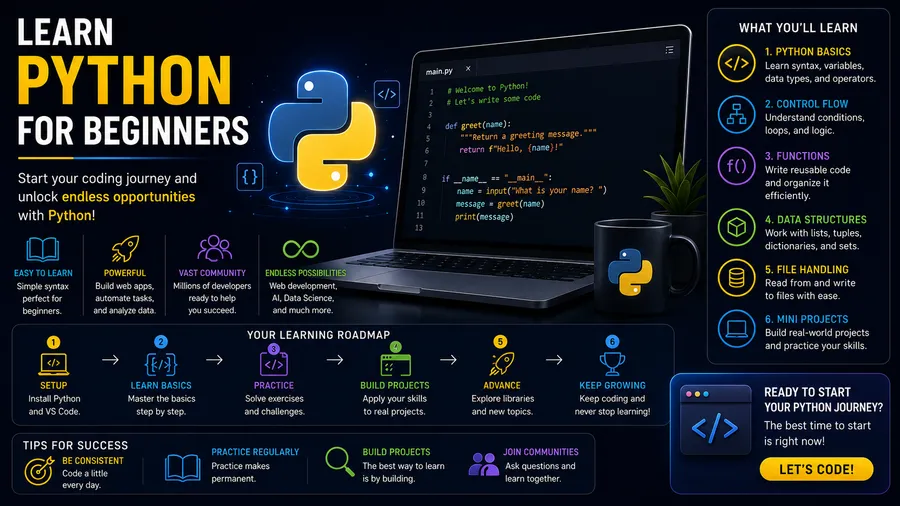
Python is widely regarded as one of the easiest programming languages to learn thanks to its clean and readable syntax.
Its enormous ecosystem of libraries makes it a leading choice for AI, automation, and scientific computing.
Advantages
- Beginner-friendly syntax
- Huge community
- Extensive libraries
- Strong job market
- Cross-platform support
Disadvantages
- Slower than some compiled languages
- Less suitable for low-level systems programming
JavaScript
Best For
- Frontend Development
- Backend Development (Node.js)
- Web Applications
- Interactive Websites
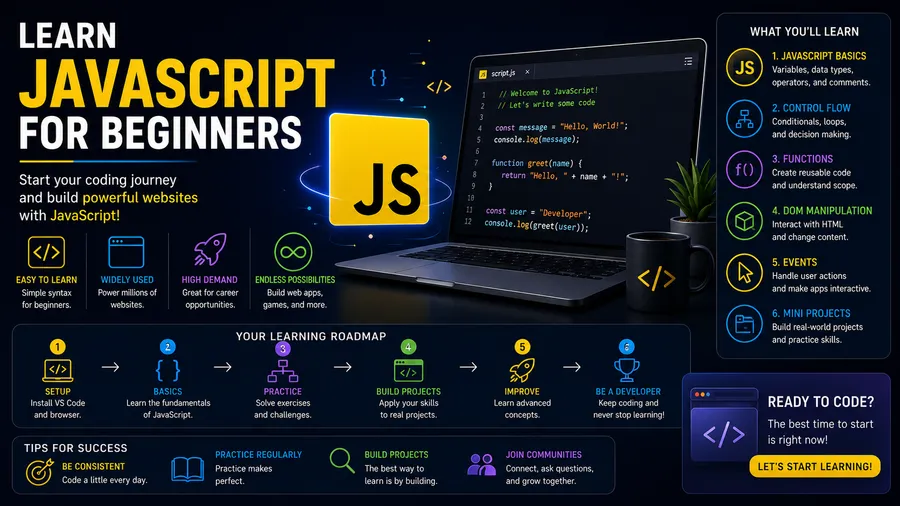
JavaScript powers the vast majority of modern websites.
Combined with HTML and CSS, it enables developers to create interactive web experiences.
Advantages
- Runs in every browser
- Massive ecosystem
- High demand
- Full-stack development opportunities
Disadvantages
- Rapidly changing ecosystem
- Can become complex in very large projects
TypeScript
TypeScript builds on JavaScript by adding static typing.
Large companies increasingly choose TypeScript because it improves code quality, maintainability, and developer productivity.
Ideal for:
- Enterprise applications
- React projects
- Angular development
- Large development teams
Java
Java remains one of the most reliable programming languages for enterprise software.
It is widely used in banking, large organizations, Android development (legacy projects), and backend systems.
Advantages include:
- Platform independence
- Excellent stability
- Strong security
- Mature ecosystem
- Long-term industry demand
C#
C# is Microsoft’s primary programming language.
It is commonly used for:
- Desktop applications
- Web APIs
- Enterprise software
- Unity game development
- Cloud services
Its modern syntax and powerful tooling make it a popular choice for both beginners and experienced developers.
C++
Best For
- Game engines
- Operating systems
- Embedded systems
- High-performance applications
- Robotics
C++ is one of the most powerful programming languages ever created.
It provides developers with direct control over memory and hardware, making it ideal for applications where maximum performance is essential.
Although it has a steeper learning curve than many modern languages, C++ remains highly relevant in industries such as gaming, finance, engineering, and systems programming.
Advantages
- Exceptional performance
- Fine-grained memory control
- Cross-platform support
- Widely used in professional software
- Large ecosystem
Disadvantages
- Difficult for beginners
- Manual memory management concepts
- More complex syntax than newer languages
Go (Golang)
Best For
- Cloud computing
- Backend APIs
- Microservices
- DevOps tools
- Networking
Created by Google, Go emphasizes simplicity, reliability, and speed.
Its lightweight syntax and excellent concurrency model make it a favorite for cloud-native applications and distributed systems.
Advantages
- Easy to learn
- Fast compilation
- Excellent concurrency
- Strong performance
- Great for backend services
Disadvantages
- Smaller ecosystem than Python or JavaScript
- Fewer built-in language features
Rust
Best For
- Systems programming
- Security-focused software
- Performance-critical applications
- Command-line tools
- Infrastructure software
Rust has gained popularity because it combines high performance with strong memory safety.
Its ownership system helps prevent entire categories of bugs without relying on a garbage collector.
Advantages
- Memory safety
- Excellent performance
- Strong reliability
- Modern language design
- Growing industry adoption
Disadvantages
- Steep learning curve
- Complex ownership model
- Longer development time for beginners
Kotlin
Best For
- Android development
- Backend services
- Multiplatform projects
Kotlin is Google’s preferred language for modern Android development.
It offers a more concise syntax than Java while remaining fully interoperable with existing Java code.
Advantages
- Modern syntax
- Excellent Android support
- Null safety
- Interoperability with Java
- Strong tooling
Disadvantages
- Smaller ecosystem than Java
- Limited use outside Android and JVM projects
Swift
Best For
- iPhone applications
- iPad applications
- macOS software
- Apple ecosystem development
Swift is Apple’s modern programming language for building applications across its platforms.
It combines performance with readability, making it a popular choice for developers targeting Apple devices.
Advantages
- Fast performance
- Beginner-friendly syntax
- Excellent Apple integration
- Strong safety features
Disadvantages
- Primarily focused on Apple platforms
- Smaller cross-platform ecosystem
PHP
Best For
- Dynamic websites
- Content management systems
- Backend web development
PHP has powered the web for decades and continues to play an important role in server-side development.
Many popular websites and content management systems rely on PHP.
Advantages
- Easy deployment
- Large community
- Extensive hosting support
- Mature ecosystem
- Beginner-friendly
Disadvantages
- Inconsistent legacy features
- Less popular for new enterprise projects than some alternatives
SQL
Best For
- Databases
- Data analysis
- Reporting
- Business intelligence
- Backend development
Unlike general-purpose programming languages, SQL is designed specifically for managing and querying relational databases.
Almost every software developer benefits from understanding SQL.
Advantages
- Essential industry skill
- Easy to learn
- Used across many technologies
- Highly valuable for data-related careers
Disadvantages
- Limited to database operations
- Often used alongside other programming languages
Language Comparison
| Language | Web | AI | Mobile | Games | Cloud | Difficulty |
|---|---|---|---|---|---|---|
| Python | ✅ | ⭐⭐⭐⭐⭐ | ⚪ | ⚪ | ⭐⭐⭐⭐ | Easy |
| JavaScript | ⭐⭐⭐⭐⭐ | ⚪ | ⚪ | ⚪ | ⭐⭐⭐ | Easy |
| TypeScript | ⭐⭐⭐⭐⭐ | ⚪ | ⚪ | ⚪ | ⭐⭐⭐⭐ | Medium |
| Java | ⭐⭐⭐ | ⚪ | ⭐⭐⭐⭐ | ⚪ | ⭐⭐⭐⭐ | Medium |
| C# | ⭐⭐⭐ | ⚪ | ⭐⭐ | ⭐⭐⭐⭐⭐ | ⭐⭐⭐ | Medium |
| C++ | ⭐⭐ | ⚪ | ⭐⭐ | ⭐⭐⭐⭐⭐ | ⭐⭐⭐ | Hard |
| Go | ⭐⭐⭐⭐ | ⚪ | ⚪ | ⚪ | ⭐⭐⭐⭐⭐ | Medium |
| Rust | ⭐⭐ | ⚪ | ⚪ | ⭐⭐ | ⭐⭐⭐⭐⭐ | Hard |
| Kotlin | ⭐⭐ | ⚪ | ⭐⭐⭐⭐⭐ | ⚪ | ⭐⭐⭐ | Medium |
| Swift | ⚪ | ⚪ | ⭐⭐⭐⭐⭐ | ⚪ | ⭐⭐ | Medium |
| PHP | ⭐⭐⭐⭐⭐ | ⚪ | ⚪ | ⚪ | ⭐⭐ | Easy |
| SQL | ⭐⭐⭐ | ⭐⭐ | ⭐⭐ | ⚪ | ⭐⭐⭐⭐ | Easy |
Which Programming Language Should You Learn?
The best language depends entirely on your goals.
Learn Python if you want to work in:
- Artificial Intelligence
- Machine Learning
- Data Science
- Automation
- Cybersecurity
Learn JavaScript if you want to build:
- Websites
- Web applications
- Full-stack projects
- Interactive user interfaces
Learn Go if you’re interested in:
- Cloud Computing
- DevOps
- Backend systems
- Scalable APIs
Learn Rust if you enjoy:
- Systems programming
- Security
- Performance optimization
- Infrastructure development
Learn Kotlin if your goal is:
- Android application development
Learn Swift if you want to create:
- iPhone applications
- iPad applications
- macOS software
Learn C# if you’re interested in:
- Unity game development
- Enterprise software
- Desktop applications
💡 Career Tip
Don’t try to learn every programming language at once. Master one language thoroughly, understand core programming concepts, and you’ll find it much easier to learn additional languages later.
Common Beginner Mistakes
Learning your first programming language is exciting, but many beginners slow their progress by making avoidable mistakes.
Here are some of the most common pitfalls and how to avoid them.
1. Choosing a Language Based Only on Popularity
A language may be popular without being the best fit for your goals.
For example:
- If you want to build websites, JavaScript is usually a better starting point than Swift.
- If you’re interested in artificial intelligence, Python is often the most practical choice.
- If your goal is Android development, Kotlin is a natural option.
Start with the language that aligns with your career path.
2. Constantly Switching Languages
Many beginners jump from Python to JavaScript, then to C++, and later to Rust without mastering any of them.
This slows learning and creates confusion.
Focus on one language until you’re comfortable building real projects before moving to another.
3. Memorizing Instead of Building
Programming isn’t about remembering every function or syntax rule.
The best way to improve is by creating projects.
Examples include:
- Calculator
- To-do list
- Personal portfolio
- Blog
- Weather app
- Simple game
Practical experience teaches much more than reading documentation alone.
4. Ignoring Computer Science Fundamentals
Learning syntax is only part of programming.
Developers should also understand:
- Variables
- Data structures
- Algorithms
- Functions
- Object-oriented programming
- Databases
- Networking basics
- Version control
These concepts transfer across nearly every programming language.
5. Being Afraid of Errors
Every programmer encounters bugs and error messages.
Debugging is a core development skill.
Instead of becoming frustrated, learn to:
- Read error messages carefully.
- Search official documentation.
- Use debugging tools.
- Break problems into smaller parts.
Over time, troubleshooting becomes much easier.
6. Comparing Yourself to Others
Programming takes time.
Some people learn quickly because they already have experience in related fields.
Focus on your own progress and build consistently.
💡 Learning Tip
Spend more time writing code than watching tutorials. Even small projects reinforce concepts and build confidence far better than passive learning.
Frequently Asked Questions
What is the easiest programming language to learn?
Python is widely considered one of the easiest programming languages because of its clean syntax and readability.
However, the best beginner language also depends on what you want to build.
Which programming language pays the highest salary?
Salaries vary depending on location, experience, industry, and specialization.
Languages commonly associated with high-paying roles include Python, Go, Rust, Java, C++, and TypeScript, particularly in fields such as AI, cloud computing, cybersecurity, and enterprise software.
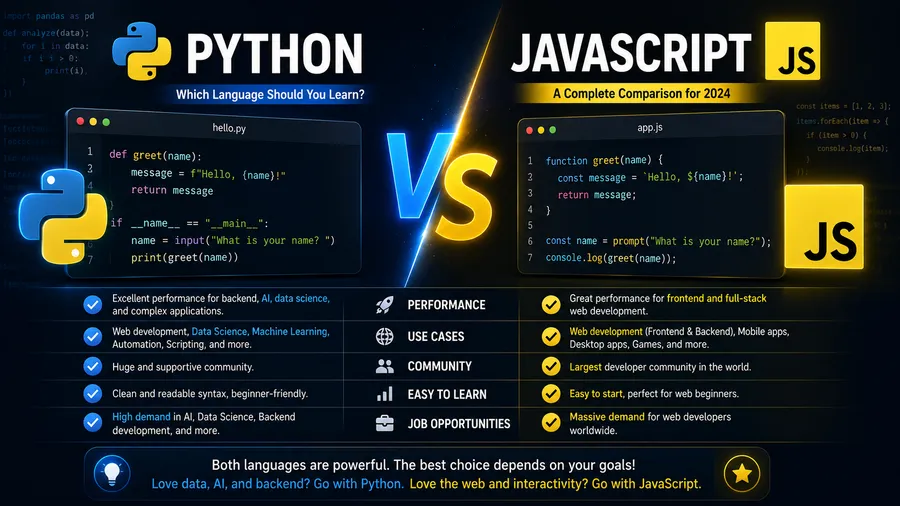
Should I learn Python or JavaScript first?
Choose Python if you’re interested in artificial intelligence, automation, or data science.
Choose JavaScript if your primary goal is web development.
Both are excellent first languages.
Is C++ still worth learning?
Yes.
C++ remains widely used in game development, operating systems, embedded systems, finance, robotics, and other performance-critical applications.
Is Java still relevant?
Absolutely.
Java continues to power many enterprise systems, financial applications, Android projects, and large backend services around the world.
Can I get a programming job without a degree?
Yes.
Many employers prioritize practical skills, problem-solving ability, and a strong portfolio over formal education.
Personal projects, open-source contributions, and internships can significantly strengthen your application.
How long does it take to learn programming?
The timeline depends on your goals and consistency.
Many beginners can understand the fundamentals within a few months, while becoming a professional developer typically requires continuous learning and regular practice.
Should I learn more than one programming language?
Yes—but not at the beginning.
Master one language first, then expand into others as your interests and career goals evolve.
Strong programming fundamentals make learning additional languages much easier.
Is programming difficult?
Programming can be challenging, especially at first.
However, consistent practice, patience, and building real projects help most learners improve steadily over time.
What should I learn after my first programming language?
After mastering one language, consider learning:
- Git and GitHub
- SQL
- APIs
- Data structures and algorithms
- Testing
- Cloud fundamentals
- Basic cybersecurity
- Software architecture principles
These complementary skills are valuable across many software development careers.
Conclusion
There is no universal “best” programming language—only the best language for your goals.
Whether you’re interested in artificial intelligence, web development, mobile apps, cloud computing, cybersecurity, game development, or enterprise software, the programming language you choose should support the type of work you want to do.
Remember that success in programming depends less on the language itself and more on your ability to solve problems, build projects, and continue learning.
Technology evolves quickly, but strong programming fundamentals remain valuable throughout your career.
Choose one language, practice consistently, build meaningful projects, and expand your skills over time.
That approach will serve you far better than chasing every new trend.
Key Takeaways
✓ There is no single best programming language for everyone.
✓ Python is an excellent choice for AI, automation, and data science.
✓ JavaScript remains essential for modern web development.
✓ Go and Rust continue to grow in cloud and systems programming.
✓ Kotlin and Swift are leading choices for Android and iOS development.
✓ Build projects instead of only studying syntax.
✓ Strong programming fundamentals matter more than any specific language.
Related Articles
Continue learning with these guides on AIZENOVA:
- Learn Python for Beginners
- Learn JavaScript for Beginners
- React vs Vue
- What Is an API?
- Git & GitHub Guide
- Astro Framework Guide
- Cybersecurity Basics
- Cloud Computing Guide
These resources will help you build practical programming skills and deepen your understanding of modern software development.
About AIZENOVA
AIZENOVA publishes practical, in-depth guides covering Programming, Artificial Intelligence, Technology, Web Development, Cybersecurity, SEO, and Digital Business.
Our mission is to help beginners and professionals develop valuable technical skills through clear explanations, real-world examples, and actionable learning resources.
Whether you’re writing your first lines of code or exploring advanced software engineering topics, AIZENOVA is here to support your learning journey.