· AIZENOVA · Business · 21 min read
AI for Business: The Complete Guide to Using Artificial Intelligence to Grow Your Business (2026)
Discover how businesses use artificial intelligence to improve productivity, reduce costs, automate tasks, enhance customer service, and increase revenue. Learn practical AI strategies, tools, benefits, challenges, and real-world examples for companies of all sizes.
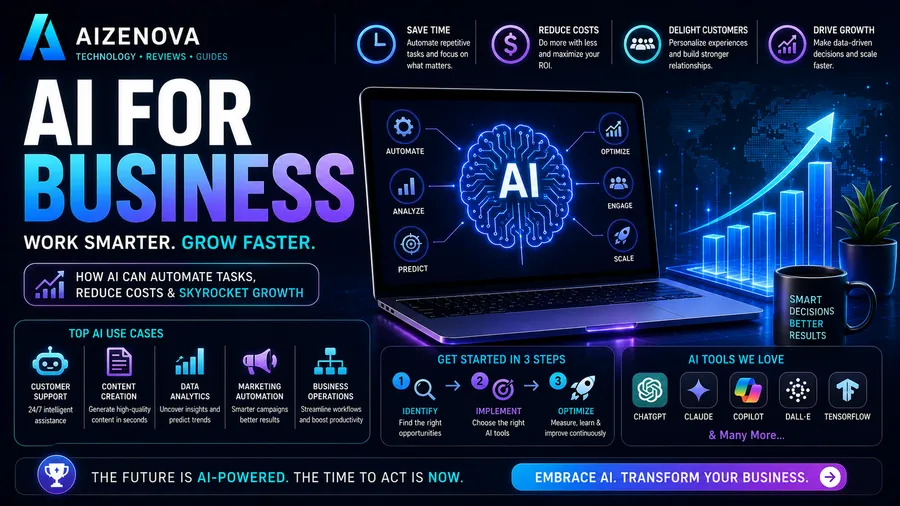
Artificial Intelligence (AI) is no longer a technology reserved for large corporations with massive budgets. Today, businesses of every size—from solo entrepreneurs and startups to multinational companies—use AI to automate repetitive tasks, improve customer experiences, analyze data faster, and make better business decisions.
Whether you run an online store, a local business, a software company, or a digital agency, AI can help you save time, reduce operational costs, and discover new opportunities for growth.
The biggest advantage of AI is not replacing people—it is helping people work smarter. Instead of spending hours on repetitive work, business owners can focus on strategy, creativity, and building stronger relationships with customers.
In this comprehensive guide, you’ll learn how AI is transforming modern businesses, the most practical ways to use it, the best AI tools available in 2026, common implementation mistakes, and proven strategies for integrating AI into your daily operations.
Quick Summary
| Difficulty | ⭐⭐☆☆☆ Beginner |
| Reading Time | 15 Minutes |
| Category | Artificial Intelligence |
| Business Impact | Very High |
| Implementation Cost | Low to Medium |
| Best For | Entrepreneurs, Small Businesses, Startups, Marketing Teams, Content Creators |
| Last Updated | August 5, 2026 |
Definition
AI for Business refers to the use of artificial intelligence technologies to automate processes, improve decision-making, increase productivity, enhance customer experiences, and support business growth.
Table of Contents
- What Is AI for Business?
- Why Businesses Are Adopting AI
- How Artificial Intelligence Works in Business
- Key Benefits of AI
- Real-World Business Applications
- Best AI Tools for Businesses
- AI for Small Businesses
- AI for Marketing
- AI for Customer Service
- AI for Sales
- AI for Finance
- AI for Human Resources
- Common Challenges
- AI Implementation Strategy
- Future of AI in Business
- Frequently Asked Questions
- Conclusion
What Is AI for Business?
Artificial intelligence in business is the practice of using intelligent software to perform tasks that traditionally required human effort.
Instead of manually analyzing data, answering customer questions, writing reports, creating marketing campaigns, or forecasting sales, AI systems can complete many of these tasks in seconds.
Modern AI technologies combine machine learning, natural language processing, computer vision, and predictive analytics to help organizations make faster and more informed decisions.
Businesses no longer use AI only to reduce costs. They also use it to increase creativity, improve efficiency, personalize customer experiences, and gain a competitive advantage.
Whether you’re running a small online shop or managing a global enterprise, AI can become a valuable assistant that works alongside your team rather than replacing it.
Why AI Matters More Than Ever
The business landscape has changed dramatically over the last few years.
Customers expect faster responses.
Employees expect smarter tools.
Markets change rapidly.
Competition grows every day.
Artificial intelligence helps companies adapt to these challenges by providing insights and automation that would otherwise require significant time and resources.
Organizations that embrace AI early often gain advantages such as:
- Faster decision-making
- Lower operational costs
- Better customer satisfaction
- Increased employee productivity
- Improved marketing performance
- More accurate forecasting
- Greater scalability
Rather than replacing business owners, AI allows them to focus on strategic decisions while routine tasks are handled automatically.
Why Businesses Are Investing in AI
Companies around the world are increasing their investments in artificial intelligence because the technology delivers measurable improvements across nearly every department.
Some organizations use AI to automate customer support, while others rely on it to generate reports, optimize advertising campaigns, detect fraud, forecast inventory, or analyze large amounts of business data.
Here are some of the biggest reasons businesses continue investing in AI:
- Reduce repetitive manual work
- Improve operational efficiency
- Make data-driven decisions
- Personalize customer experiences
- Increase employee productivity
- Reduce human error
- Save time across departments
- Discover new business opportunities
- Improve profitability
- Stay competitive in rapidly changing markets
AI has evolved from an experimental technology into an essential business tool.
Companies that successfully integrate AI often become more agile, more efficient, and better prepared for future challenges.
💡 Business Insight
The most successful businesses don’t use AI to replace employees—they use it to eliminate repetitive work, allowing teams to focus on creativity, innovation, and solving complex problems.
How Does AI Work in Business?
Although artificial intelligence may seem complex, its role in business can be understood through a simple process.
Most AI systems follow a structured workflow that transforms data into actionable insights.
Step 1 — Collect Data
Businesses gather information from multiple sources, including:
- Customer interactions
- Website analytics
- Sales reports
- CRM systems
- Financial records
- Social media platforms
- Email campaigns
The quality of this data directly influences the quality of AI-generated insights.
Step 2 — Analyze Patterns
AI algorithms process enormous amounts of information much faster than humans.
Instead of simply storing data, AI identifies patterns, trends, and relationships that may not be immediately obvious.
For example, an online retailer can discover which products customers frequently purchase together.
Step 3 — Generate Insights
Once patterns are identified, AI transforms raw information into recommendations that support business decisions.
Examples include:
- Predicting future sales
- Identifying customer preferences
- Detecting unusual transactions
- Forecasting inventory demand
- Recommending pricing adjustments
These insights help businesses respond more quickly to changing market conditions.
Step 4 — Automate Tasks
Modern AI tools can automatically perform repetitive activities such as:
- Writing emails
- Scheduling meetings
- Generating reports
- Responding to customer inquiries
- Creating marketing content
- Organizing business documents
Automation reduces manual work while improving consistency and efficiency.
Step 5 — Learn and Improve
Many AI systems continue learning as they process additional information.
Over time, they become better at making predictions, identifying trends, and supporting decision-making.
This continuous improvement is one of the reasons AI has become such a valuable business asset.
How AI Supports Daily Business Operations
Business Data
      │
      ▼
AI Analysis
      │
      ▼
Insights & Recommendations
      │
      ▼
Automation
      │
      ▼
Better Decisions
      │
      ▼
Business Growth
---

# Key Benefits of AI for Business

Artificial intelligence offers advantages that extend far beyond simple automation.

Businesses that implement AI effectively often improve efficiency, reduce operational costs, enhance customer satisfaction, and make better decisions using real-time data.

Below are some of the most significant benefits.

---

## Increased Productivity

One of AI's greatest strengths is its ability to complete repetitive tasks much faster than humans.

Instead of spending hours creating reports, organizing spreadsheets, answering common customer questions, or writing first drafts of documents, employees can focus on strategic work that requires creativity and critical thinking.

Examples include:

- Automatically generating reports
- Scheduling appointments
- Organizing files
- Drafting emails
- Summarizing meetings
- Managing calendars

When repetitive work is automated, teams can accomplish more in less time.

---

## Lower Operating Costs

Automation helps businesses reduce expenses by minimizing manual work and improving operational efficiency.

For example, AI chatbots can answer thousands of customer questions every day without requiring additional support staff for common requests.

Similarly, AI-powered accounting software can process invoices, categorize expenses, and detect unusual transactions automatically.

Reducing repetitive work allows businesses to allocate their budgets more efficiently.

---

## Better Decision-Making

Modern businesses generate enormous amounts of data every day.

Without AI, analyzing this information can take hours—or even days.

AI systems identify patterns, predict trends, and provide recommendations within seconds.

Business leaders can use these insights to make more informed decisions based on evidence rather than assumptions.

Examples include:

- Sales forecasting
- Inventory planning
- Customer behavior analysis
- Marketing optimization
- Risk assessment

---

## Improved Customer Experience

Customers increasingly expect fast, personalized service.

AI helps businesses deliver better experiences through:

- Personalized recommendations
- Instant chatbot responses
- Smart search functionality
- Product suggestions
- Automated email support
- 24/7 customer assistance

Satisfied customers are more likely to return and recommend your business to others.

---

## Higher Marketing Performance

Marketing teams use AI to understand customer behavior, optimize advertising campaigns, and generate content more efficiently.

AI can assist with:

- Writing ad copy
- Creating social media posts
- Keyword research
- Email marketing
- Customer segmentation
- Campaign performance analysis

Rather than replacing marketers, AI helps them work more effectively.

---

## Faster Content Creation

Creating business content often requires significant time.

AI accelerates this process by helping teams produce:

- Blog articles
- Product descriptions
- Marketing emails
- Landing page copy
- Video scripts
- Social media captions

Human editing remains essential, but AI dramatically reduces the time needed to create first drafts.

---

## Competitive Advantage

Businesses that adopt AI early often gain an advantage over competitors.

They can respond to market changes faster, analyze customer behavior more effectively, and improve internal operations before others catch up.

AI has become a strategic investment rather than simply another software tool.

---

## Real-World Applications of AI in Business

Artificial intelligence is already transforming industries across the world.

Below are some practical examples of how businesses use AI every day.

| Industry | AI Application | Business Benefit |
|----------|----------------|------------------|
| E-commerce | Product recommendations | Higher sales |
| Retail | Inventory forecasting | Lower waste |
| Healthcare | Medical data analysis | Faster diagnosis support |
| Banking | Fraud detection | Increased security |
| Marketing | Personalized campaigns | Better conversion rates |
| Education | Personalized learning | Improved student engagement |
| Customer Support | AI chatbots | Faster response times |
| Manufacturing | Predictive maintenance | Reduced downtime |
| Logistics | Route optimization | Lower delivery costs |
| Human Resources | Resume screening | Faster recruitment |

These examples demonstrate that AI is no longer limited to technology companies.

Organizations across nearly every industry now rely on AI to improve efficiency and deliver better services.

---

> 💡 **Business Insight**
>
> The companies achieving the best results with AI usually start with a single business problem. After proving measurable improvements, they gradually expand AI into additional departments instead of trying to transform the entire organization at once.

---

# Best AI Tools for Businesses in 2026

Choosing the right AI software depends on your business goals.

Some tools focus on content creation, while others specialize in automation, customer support, data analysis, or project management.

Below are some of the most widely used AI tools by businesses.

| AI Tool | Best For | Main Use |
|---------|----------|----------|
| ChatGPT | Content & Productivity | Writing, brainstorming, research |
| Claude | Long-form writing | Documents and analysis |
| Gemini | Google Workspace | Productivity and collaboration |
| Microsoft Copilot | Microsoft 365 | Office automation |
| Notion AI | Documentation | Notes and knowledge management |
| Canva AI | Design | Marketing graphics |
| Midjourney | Image generation | Creative visuals |
| GitHub Copilot | Developers | Coding assistance |
| Perplexity AI | Research | Fast information discovery |
| Zapier AI | Workflow automation | Connecting business apps |

Every business has different needs.

Rather than subscribing to many AI tools at once, begin with one or two platforms that solve your biggest operational challenges.

---

# AI for Small Businesses

Many small business owners assume artificial intelligence is only useful for large corporations.

In reality, small businesses often benefit the most because they usually operate with limited staff and tighter budgets.

AI allows entrepreneurs to automate repetitive tasks without hiring additional employees.

Examples include:

- Writing product descriptions
- Creating invoices
- Scheduling appointments
- Managing customer support
- Generating marketing content
- Responding to emails
- Organizing documents

These improvements help business owners spend more time growing their companies instead of handling administrative work.

---

## Practical Example

Imagine you own a small online clothing store.

Without AI, your daily routine may include:

- Answering customer emails
- Writing product descriptions
- Updating inventory
- Creating social media posts
- Tracking sales
- Preparing weekly reports

With AI assistance, many of these tasks can be completed automatically or significantly faster.

Instead of spending six hours on administrative work, you may only need two—leaving more time to focus on customer relationships, product sourcing, and business growth.

---

> ⚠️ **Common Mistake**
>
> Some businesses expect AI to replace every employee. In reality, AI performs best when it supports people rather than replacing them. Human creativity, judgment, and relationship-building remain essential for long-term success.
---

# AI for Marketing

Marketing is one of the areas where artificial intelligence delivers the fastest return on investment.

Modern marketing teams use AI to understand customer behavior, generate high-quality content, optimize advertising campaigns, and personalize experiences across multiple channels.

Instead of replacing marketers, AI removes repetitive tasks and provides valuable insights that help teams make smarter decisions.

---

## Content Creation

Creating consistent, high-quality content is one of the biggest challenges for businesses.

AI helps marketers produce first drafts for:

- Blog posts
- Landing pages
- Product descriptions
- Email newsletters
- Social media captions
- Advertising copy

While AI accelerates content production, human review remains essential to ensure accuracy, originality, and brand consistency.

---

## Search Engine Optimization (SEO)

SEO requires keyword research, content planning, internal linking, and continuous optimization.

AI can assist by:

- Finding keyword opportunities
- Generating content outlines
- Suggesting title ideas
- Writing meta descriptions
- Identifying content gaps
- Improving readability

Businesses that combine AI with strong SEO strategies can publish content more efficiently while maintaining quality.

---

## Email Marketing

AI-powered email platforms help businesses create personalized campaigns based on customer behavior.

Instead of sending the same message to everyone, AI can recommend different content for different audiences.

Examples include:

- Personalized product recommendations
- Automated follow-up emails
- Customer re-engagement campaigns
- Welcome email sequences
- Abandoned cart reminders

Personalized communication often improves open rates and customer engagement.

---

## Advertising Optimization

Running online advertisements requires continuous testing.

AI helps businesses improve advertising performance by analyzing campaign data and recommending optimizations.

Examples include:

- Audience targeting
- Budget allocation
- Performance forecasting
- Ad copy suggestions
- Keyword optimization
- Conversion analysis

Rather than guessing which advertisements perform best, businesses can make decisions based on data.

---

# AI for Customer Service

Customer support has changed dramatically with the introduction of artificial intelligence.

Businesses can now provide instant assistance around the clock while reducing response times and improving customer satisfaction.

---

## AI Chatbots

AI chatbots can answer common customer questions within seconds.

Typical examples include:

- Order tracking
- Business hours
- Product availability
- Return policies
- Frequently asked questions
- Appointment scheduling

When a request becomes more complex, the conversation can be transferred to a human support representative.

This combination creates a better customer experience without eliminating the human element.

---

## Personalized Support

Artificial intelligence can analyze previous customer interactions to provide more personalized recommendations.

For example, an online store may recommend products based on previous purchases or browsing history.

Personalization increases customer satisfaction while improving sales opportunities.

---

## Faster Response Times

Waiting several hours for customer support is no longer acceptable for many consumers.

AI enables businesses to respond immediately to routine questions, improving both efficiency and customer trust.

---

> 💡 **Business Insight**
>
> AI should enhance customer service—not replace genuine human interaction. The best businesses combine automation with knowledgeable support teams capable of solving more complex issues.

---

# AI for Sales

Sales teams spend a significant amount of time on administrative work rather than selling.

Artificial intelligence helps reduce this workload while improving sales performance.

---

## Lead Qualification

Not every lead is equally valuable.

AI can analyze customer behavior and identify prospects who are most likely to become paying customers.

This allows sales representatives to focus on opportunities with the highest potential.

---

## Sales Forecasting

Predicting future sales is essential for planning inventory, budgeting, and staffing.

AI analyzes historical sales data, seasonal trends, and customer behavior to produce more accurate forecasts.

Although predictions are never perfect, they often outperform manual estimates.

---

## CRM Automation

Customer Relationship Management (CRM) systems become more powerful when combined with AI.

Common automations include:

- Updating customer records
- Scheduling follow-up reminders
- Tracking communication history
- Generating sales summaries
- Identifying inactive customers

Automation reduces administrative work and helps sales teams stay organized.

---

## Product Recommendations

Many online stores use AI recommendation engines to suggest products customers are likely to purchase.

Examples include:

- Frequently bought together
- Similar products
- Personalized recommendations
- Recently viewed items

These recommendations often increase average order value and improve customer satisfaction.

---

# AI for Finance

Financial management involves large amounts of data that AI can process quickly and accurately.

Businesses increasingly rely on AI to improve financial operations while reducing manual work.

---

## Expense Management

AI-powered accounting software can automatically:

- Categorize expenses
- Process invoices
- Detect duplicate payments
- Generate financial reports
- Track spending trends

Automation improves efficiency while reducing accounting errors.

---

## Fraud Detection

Banks and payment providers use AI to identify suspicious transactions in real time.

Instead of relying solely on predefined rules, AI analyzes unusual spending patterns and alerts businesses to potential fraud.

This helps reduce financial losses and improve security.

---

## Budget Forecasting

Business leaders need accurate forecasts when planning future investments.

AI helps estimate:

- Revenue growth
- Operating expenses
- Cash flow
- Seasonal demand
- Business risks

Better forecasting supports more informed financial decisions.

---

# AI for Human Resources

Recruiting, onboarding, and managing employees require considerable time and effort.

Artificial intelligence helps HR teams streamline these processes while improving efficiency.

---

## Resume Screening

Large companies may receive hundreds—or even thousands—of job applications.

AI can quickly identify candidates who match predefined qualifications, allowing recruiters to spend more time evaluating the strongest applicants.

Human review remains essential to ensure fair hiring decisions.

---

## Employee Onboarding

AI assistants can guide new employees through onboarding by answering common questions, explaining company policies, and providing access to training resources.

This reduces the workload for HR teams while improving the experience for new hires.

---

## Learning and Development

AI-powered learning platforms can recommend personalized training programs based on an employee's role, skills, and career goals.

Personalized learning helps employees develop more efficiently while supporting long-term business growth.

---

## Workforce Analytics

HR departments increasingly use AI to analyze workforce data such as:

- Employee engagement
- Staff turnover
- Recruitment performance
- Training effectiveness
- Productivity trends

These insights help organizations make better decisions regarding hiring, retention, and professional development.

---

> 💡 **Pro Tip**
>
> Successful businesses introduce AI gradually. Start with one department—such as marketing or customer support—measure the results, and expand your AI strategy once you've demonstrated clear business value.
---

# Challenges of Using AI in Business

Although artificial intelligence offers significant advantages, adopting AI is not without challenges.

Businesses that understand these obstacles early are more likely to implement AI successfully and achieve long-term results.

---

## Data Quality

Artificial intelligence depends on data.

If your business provides incomplete, outdated, or inaccurate information, AI systems may generate unreliable recommendations.

This is why many companies spend time improving their data before introducing AI into important workflows.

**Remember:**

> Better data leads to better AI results.

---

## Employee Training

Introducing AI changes how people work.

Without proper training, employees may struggle to use new tools effectively or become resistant to change.

Businesses should invest in practical training and explain how AI supports employees rather than replacing them.

---

## Privacy and Security

Businesses often process sensitive customer and company information.

Before using AI platforms, organizations should understand:

- Where data is stored
- How information is processed
- Who can access the data
- Whether the provider complies with relevant privacy regulations

Protecting customer trust should always remain a priority.

---

## Implementation Costs

Many AI tools offer affordable plans, but implementing AI across an entire organization may involve additional costs such as:

- Software subscriptions
- Employee training
- System integration
- Process redesign
- Ongoing maintenance

Instead of adopting many AI platforms at once, businesses usually benefit from starting with one high-impact solution.

---

## Human Oversight

AI can generate impressive results, but it is not perfect.

Incorrect information, biased outputs, or misunderstood instructions can still occur.

For this reason, businesses should always review important AI-generated work before publishing or making critical decisions.

---

> ⚠️ **Important**
>
> Artificial intelligence should assist business decisions—not replace human judgment. Final decisions involving finances, legal matters, hiring, or customer relationships should always include human review.

---

# How to Implement AI Successfully

Many businesses fail with AI because they try to automate everything immediately.

A more effective strategy is to introduce AI gradually while measuring results at every stage.

Below is a practical roadmap that businesses of any size can follow.

---

## Step 1 — Identify Repetitive Tasks

Begin by identifying activities that consume significant time.

Examples include:

- Responding to emails
- Writing reports
- Scheduling meetings
- Managing customer inquiries
- Creating social media posts
- Processing invoices

These tasks are often ideal candidates for automation.

---

## Step 2 — Choose One AI Tool

Avoid subscribing to multiple AI platforms at the beginning.

Instead, select one tool that solves your most important problem.

Starting small makes implementation easier and allows your team to gain confidence before expanding.

---

## Step 3 — Train Your Team

Technology alone does not create success.

Employees should understand:

- What AI can do
- What AI cannot do
- How to write effective prompts
- When human review is necessary

Well-trained teams consistently achieve better results.

---

## Step 4 — Measure Performance

Track measurable improvements such as:

- Time saved
- Customer satisfaction
- Revenue growth
- Marketing performance
- Cost reduction
- Employee productivity

These metrics help determine whether your AI investment delivers real value.

---

## Step 5 — Expand Gradually

After achieving success in one department, consider introducing AI into additional business functions.

Examples include:

- Marketing
- Sales
- Customer support
- Human resources
- Finance
- Operations

Gradual expansion reduces risk while improving long-term adoption.

---

## AI Adoption Roadmap

```text
Identify Repetitive Tasks
            │
            ▼
Choose One AI Tool
            │
            ▼
Train Employees
            │
            ▼
Measure Results
            │
            ▼
Improve Processes
            │
            ▼
Expand AI Across Departments
The Future of AI in Business
Artificial intelligence continues to evolve rapidly.
Over the next several years, businesses are expected to rely even more heavily on AI for automation, decision-making, and customer engagement.
Some emerging trends include:
- AI-powered digital assistants for employees
- More advanced business analytics
- Smarter cybersecurity systems
- Personalized customer experiences
- Autonomous business workflows
- AI-generated software development
- Predictive business planning
- Intelligent supply chain management
Rather than replacing businesses, AI will become a standard business tool—similar to email, cloud computing, or customer relationship management software.
Companies that begin learning and adopting AI today will likely be better prepared for tomorrow’s opportunities.
💡 Business Insight
The future belongs to businesses that combine human creativity with artificial intelligence. AI provides speed and efficiency, while people contribute strategy, innovation, ethics, and meaningful relationships.
Frequently Asked Questions
What is AI for business?
AI for business refers to the use of artificial intelligence to automate tasks, analyze data, improve decision-making, enhance customer experiences, and increase overall productivity.
Is AI only useful for large companies?
No.
Small businesses, freelancers, startups, and entrepreneurs can benefit from AI just as much as large organizations.
Many affordable AI tools are specifically designed for smaller teams.
Can AI replace employees?
In most cases, no.
AI is best viewed as a productivity assistant that automates repetitive work while allowing employees to focus on higher-value tasks requiring creativity and critical thinking.
What is the biggest benefit of AI for businesses?
The greatest advantage is improved efficiency.
Businesses can save time, reduce costs, automate routine processes, and make faster, data-driven decisions.
Is AI expensive to implement?
Not necessarily.
Many businesses start with low-cost subscription-based AI tools before investing in larger enterprise solutions.
The cost depends on business size and implementation goals.
Which industries benefit the most from AI?
AI is widely used in:
- Retail
- Healthcare
- Finance
- Manufacturing
- Marketing
- Education
- Software Development
- Customer Service
- Logistics
- Human Resources
Nearly every industry can benefit from AI in some capacity.
Can AI improve customer service?
Yes.
AI chatbots, automated support systems, and personalized recommendations help businesses respond faster while improving customer satisfaction.
Is AI safe for businesses?
AI can be safe when used responsibly.
Businesses should implement strong security practices, protect customer data, and review AI-generated outputs before making important decisions.
Do small businesses really need AI?
Not every business needs advanced AI systems.
However, even simple AI tools can save significant time by automating repetitive administrative work and improving daily productivity.
Will AI continue changing business in the future?
Almost certainly.
Artificial intelligence is expected to become an increasingly important part of business operations across nearly every industry.
Organizations that learn how to use AI effectively today will be better prepared for future innovation.
Conclusion
Artificial intelligence is transforming the way businesses operate.
From automating routine tasks and improving customer service to supporting smarter decision-making and increasing productivity, AI offers practical advantages for organizations of every size.
The most successful companies are not those that replace people with AI—they are the ones that empower people through AI.
By starting with small improvements, investing in employee training, and focusing on real business challenges, organizations can build sustainable long-term value while remaining competitive in an increasingly digital world.
Whether you’re a freelancer, startup founder, small business owner, or enterprise leader, now is an excellent time to begin exploring how artificial intelligence can support your business goals.
Key Takeaways
✓ AI helps businesses automate repetitive tasks.
✓ Better data leads to better AI-powered decisions.
✓ Small businesses can benefit just as much as large organizations.
✓ Human oversight remains essential for important decisions.
✓ AI improves productivity, efficiency, and customer satisfaction.
✓ Start with one AI solution before expanding across your business.
✓ Businesses that adopt AI strategically are better positioned for long-term growth.
About AIZENOVA
AIZENOVA publishes practical guides covering Artificial Intelligence, Programming, Technology, Business, SEO, and Digital Marketing.
Our mission is to help entrepreneurs, developers, students, and professionals understand modern technology through detailed tutorials, actionable insights, honest reviews, and beginner-friendly learning resources.
Explore more expert guides on AIZENOVA to stay informed about the latest AI trends, business strategies, programming tutorials, and emerging technologies shaping the future.