· Hamza · Technology · 4 min read
Cloud Computing Guide: Everything You Need to Know in 2026
Learn what cloud computing is, how it works, its service models, deployment types, benefits, challenges, and why businesses rely on cloud technology.
Cloud Computing Guide: Everything You Need to Know in 2026
Cloud computing has transformed the way businesses and individuals store data, run applications, and deliver online services. Instead of relying on physical servers or local computers, organizations can access computing resources over the internet whenever they need them.
In this guide, you’ll learn what cloud computing is, how it works, the different cloud service models, deployment options, advantages, challenges, and why it has become a cornerstone of modern technology.
What Is Cloud Computing?
Cloud computing is the delivery of computing services over the internet.
Instead of purchasing and maintaining expensive hardware, users rent computing resources such as:
- Servers
- Storage
- Databases
- Networking
- Software
- Artificial Intelligence services
- Analytics tools
Users pay only for the resources they consume.
How Cloud Computing Works
Cloud providers operate large data centers around the world.
When users access a cloud service:
- A request is sent over the internet.
- The cloud provider processes the request.
- Resources are allocated automatically.
- The requested service or data is delivered.
- Resources can scale up or down depending on demand.
This allows businesses to operate without managing physical infrastructure.
Types of Cloud Computing
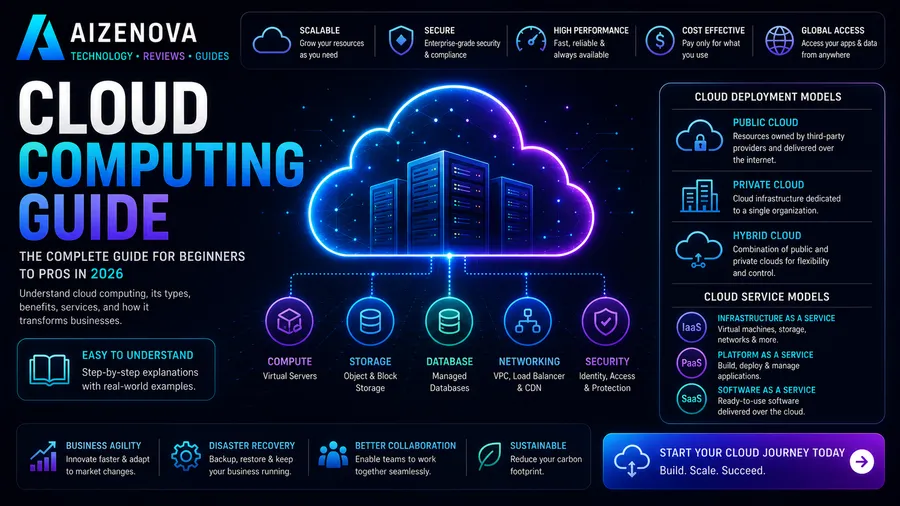
1. Public Cloud
Public cloud services are owned and managed by third-party providers.
Examples include:
- Amazon Web Services (AWS)
- Microsoft Azure
- Google Cloud
Advantages
- Low cost
- High scalability
- No hardware maintenance
2. Private Cloud
A private cloud is dedicated to a single organization.
It offers:
- Greater security
- Better control
- Custom infrastructure
Private clouds are commonly used by governments, healthcare organizations, and financial institutions.
3. Hybrid Cloud
A hybrid cloud combines public and private cloud environments.
Organizations can:
- Store sensitive data privately
- Use public cloud resources for scalability
- Balance security and cost
Many modern enterprises use hybrid cloud strategies.
Cloud Service Models
Infrastructure as a Service (IaaS)
IaaS provides virtual servers and networking resources.
Examples:
- Virtual machines
- Storage
- Networking
- Firewalls
Ideal for developers and IT teams that need maximum control.
Platform as a Service (PaaS)
PaaS provides a complete environment for building and deploying applications.
Developers don’t need to manage servers.
Examples include:
- Application hosting
- Databases
- Development frameworks
Software as a Service (SaaS)
SaaS delivers software directly through a web browser.
Examples include:
- Email services
- Office applications
- Video conferencing
- Customer relationship management (CRM)
Users simply log in and start working.
Benefits of Cloud Computing
Cloud computing offers many advantages:
- Lower infrastructure costs
- High availability
- Automatic updates
- Easy scalability
- Global accessibility
- Faster deployment
- Improved collaboration
- Built-in disaster recovery
- Better business continuity
These benefits help organizations remain flexible and competitive.
Common Uses of Cloud Computing
Cloud technology powers countless modern services, including:
- Website hosting
- Mobile applications
- Streaming platforms
- Artificial Intelligence
- Machine Learning
- Data backup
- Online gaming
- E-commerce
- Business software
- Big data analytics
Many everyday digital experiences rely on cloud infrastructure.
Popular Cloud Providers
Amazon Web Services (AWS)
AWS is one of the largest cloud providers in the world.
Popular services include:
- EC2
- S3
- Lambda
- RDS
- CloudFront
Microsoft Azure
Azure integrates well with Microsoft products and enterprise environments.
Common services include:
- Virtual Machines
- Azure SQL
- Azure AI
- Azure Storage
Google Cloud Platform (GCP)
Google Cloud is known for:
- Artificial Intelligence
- Data analytics
- Kubernetes
- Machine Learning
- BigQuery
It is widely used by startups and technology companies.
Cloud Security
Cloud providers invest heavily in security.
Best practices include:
- Multi-factor authentication (MFA)
- Data encryption
- Regular backups
- Access control
- Security monitoring
- Identity management
Businesses also share responsibility for securing their applications and data.
Challenges of Cloud Computing
Despite its advantages, cloud computing has some challenges:
- Internet dependency
- Vendor lock-in
- Data privacy concerns
- Compliance requirements
- Service outages
- Ongoing subscription costs
Proper planning helps reduce these risks.
Cloud Computing Careers
Cloud computing professionals are in high demand.
Popular roles include:
- Cloud Engineer
- Cloud Architect
- DevOps Engineer
- Solutions Architect
- Security Engineer
- Site Reliability Engineer (SRE)
- Cloud Consultant
Knowledge of AWS, Azure, or Google Cloud is valuable for many IT careers.
Frequently Asked Questions
Is cloud computing difficult to learn?
Not necessarily. Beginners can start by understanding cloud fundamentals before learning platforms such as AWS, Azure, or Google Cloud.
Which cloud platform should beginners learn?
AWS is often recommended because of its large market share and extensive learning resources. Azure and Google Cloud are also excellent choices depending on your career goals.
Is cloud computing a good career?
Yes. Cloud computing remains one of the fastest-growing areas in technology, with strong demand for skilled professionals across many industries.
Is cloud computing secure?
Cloud platforms provide robust security features, but organizations must also configure and manage their systems responsibly.
Do I need programming skills?
Basic programming knowledge is helpful but not always required. Many cloud roles focus on infrastructure, networking, automation, or security rather than software development.
Conclusion
Cloud computing has become the foundation of modern digital services, enabling businesses to scale quickly, reduce infrastructure costs, and innovate faster. From startups to global enterprises, organizations rely on cloud platforms to host applications, store data, and power AI-driven solutions.
Whether you’re an IT professional, developer, student, or business owner, learning cloud computing is a valuable investment. Understanding cloud concepts today will help you build the skills needed for tomorrow’s technology landscape.